Yemen's UN Envoy: We Regret Failure to Classify Houthis as a Terrorist Organization
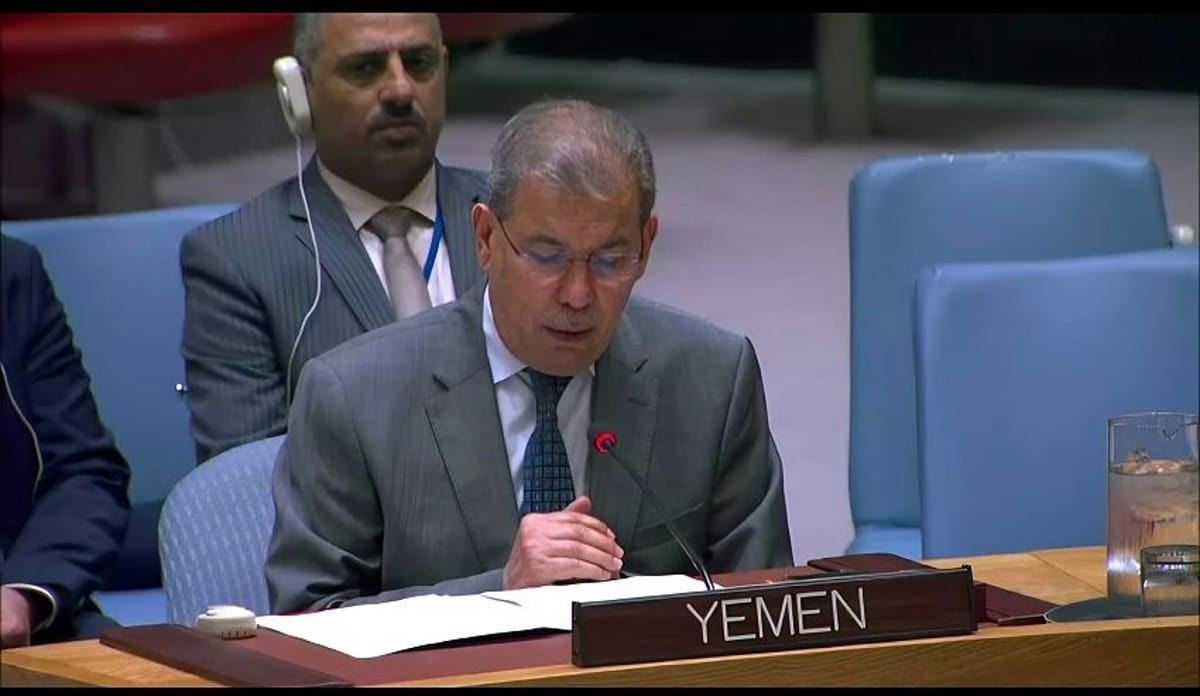
The Yemeni government has expressed its regret that the UN Security Council was unable to agree on classifying the Houthi group as a terrorist organization, despite condemning its military escalation and demanding a halt to its attacks. At the same time, it welcomed the renewal of the sanctions regime imposed on Yemen and the strengthening of arms embargo measures.
Yemen's Permanent Representative to the United Nations, Ambassador Abdullah Al-Saadi, stated that the adoption of the resolution renewing the sanctions regime established under Resolution 2140 (2014) comes amid a dangerous escalation in Yemen and the region. This includes the Houthis' continued attacks on civilians and infrastructure, their cross-border assaults, and their threats to maritime security and freedom of navigation in the Red Sea, the Bab el-Mandeb Strait, and the Gulf of Aden.
In Yemen's statement during the Security Council session to vote on the draft resolution, Al-Saadi added that while the government welcomes the clear condemnation of the Houthi military escalation and the demand for the group to cease its escalation and attacks immediately and unconditionally, it regrets the Council's inability to describe the Houthis as a terrorist group. This is in light of their record of targeting civilians, civilian facilities, and commercial ships, and committing serious violations of human rights and international humanitarian law.
He emphasized that the absence of this classification from the resolution's text does not diminish the gravity of the violations committed, nor does it absolve those responsible and their supporters from accountability. He stressed that achieving peace and stability in Yemen and the region requires a clearer and more decisive international stance against the group and its practices.
The Yemeni government welcomed the inclusion of additional provisions in the resolution to enhance the implementation of the arms embargo imposed under Resolution 2216 (2015), considering it a step towards curbing the flow of weapons, their components, and military technology that enable the Houthis to continue their attacks and expand their military capabilities.
It called for these measures to be translated into practical actions to close loopholes exploited by arms smuggling networks and illicit supply chains. It noted that the group's continued access to advanced weapons, dual-use components, and its growing capacity for local arms manufacturing, including drones, pose an increasing threat that requires a more robust and coordinated international response.
It also welcomed the expansion of the mandate of the Panel of Experts on Yemen, increasing its members to six, adding experts specializing in maritime security issues, and broadening its tasks to include tracking dual-use components used in Houthi weapon systems. This also includes enhancing information exchange on ships suspected of transporting weapons or related equipment and monitoring the revenue sources that finance the group's activities.
The government commended the expansion of the criteria for sanctions listing to include threatening to attack commercial vessels, cross-border attacks with ballistic and cruise missiles and drones, and the arbitrary detention of UN staff, diplomatic mission personnel, and humanitarian workers.
In this context, it demanded a comprehensive and transparent international investigation into the death of a UN staff member while in Houthi custody and called for holding those responsible for violations against civilians accountable, including the siege imposed on the city of Taiz and the obstruction of access to food, medicine, and humanitarian aid.
It called for the immediate and unconditional release of all detainees, the lifting of the siege on Taiz, and ensuring unimpeded access for humanitarian aid to the population.
The government affirmed its readiness to continue cooperating with the Sanctions Committee, the Panel of Experts, and member states, and to provide the necessary information and facilities to implement the resolution, combat arms smuggling, and dry up the sources of funding and armament that support the Houthis.
It stressed that sanctions are not an end in themselves but a tool to support peace efforts, deter actions that threaten the security and stability of Yemen and regional and international peace, protect civilians, and ensure respect for Security Council resolutions.
The government reiterated its commitment to achieving a comprehensive and sustainable peace based on the agreed-upon terms of reference, foremost among them the Gulf Initiative and its implementation mechanism, the outcomes of the National Dialogue Conference, and Security Council resolutions, particularly Resolution 2216.
Source: Saba Net