Hadhramaut: Folk artist Karama Alwa dies at the age of 100
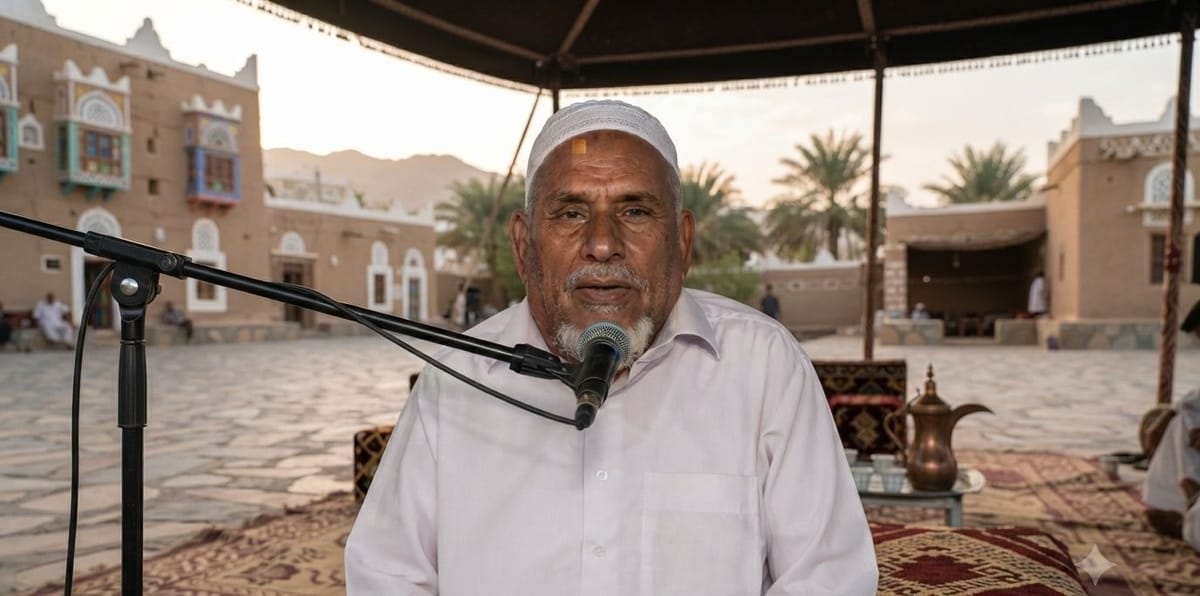
Hadhrami folk artist Karama Humaid Salem Alwa passed away on Monday evening at the age of 100, after a decades-long artistic and heritage career during which his name became associated with the art of "Bani Maghrah" in the city of Tarim.
The Al-Ranad Foundation for Cultural Development mourned the late artist, describing him as one of the pioneers of the "Bani Maghrah" art in Tarim and Hadhramaut, noting his status in the local cultural, artistic, and heritage community.
Alwa, born in 1925, was considered one of the most prominent singers of "Bani Maghrah" in Tarim and Hadhramaut. He began practicing this art at the age of twelve, before gaining wider recognition and starting his professional career at sixteen, later becoming one of its most famous performers.
During his long career, Alwa performed poems by several Hadhrami poets. One of the most famous works associated with his voice is the poem "Ma Shi Kama Al-Tamr fi Al-Dar" (Nothing is Like Dates at Home). He also contributed to preserving and presenting a number of poems dealing with romance, descriptions of events, social life, and daily realities.
Alwa's contributions were not limited to singing; his name was also associated with preserving Hadhrami folk heritage and participating in events and artistic works with his "Bani Maghrah" troupe, making him one of the prominent figures of this traditional genre in Hadhramaut.
"Bani Maghrah" is a traditional art form characteristic of Hadhramaut, especially the city of Tarim and the Hadhramaut Valley regions. It is an art that combines singing, dancing, and group performance, performed especially at social occasions and celebrations. It has distinctive rhythms and performance styles, with folk poetry and singing forming a fundamental part of its artistic structure.
According to what was reported from the artist Karama Alwa, "Bani Maghrah" is a Hadhrami dance and performance known in the region, with four performance methods to a single rhythm, including the Tarimi method, which he described as the easiest and most widely practiced.
The transmission of this art among singers and poets contributed to preserving an important part of Hadhramaut's artistic and social memory, and Alwa remained one of the most prominent voices associated with it throughout the last century and into the final years of his life.
With the passing of Karama Alwa, Tarim and Hadhramaut lose one of the most prominent symbols of the popular "Bani Maghrah" art, after nearly seven decades of presence in the artistic and heritage scene, leaving behind a legacy of poems, melodies, and performances linked to one of the most significant genres of Hadhrami heritage.
Source: Al-Mahriah Net + Open sources