Al-Zubaidi's Return with Separatist Speech Raises Questions About Its Timing and Messages to Saudi Arabia
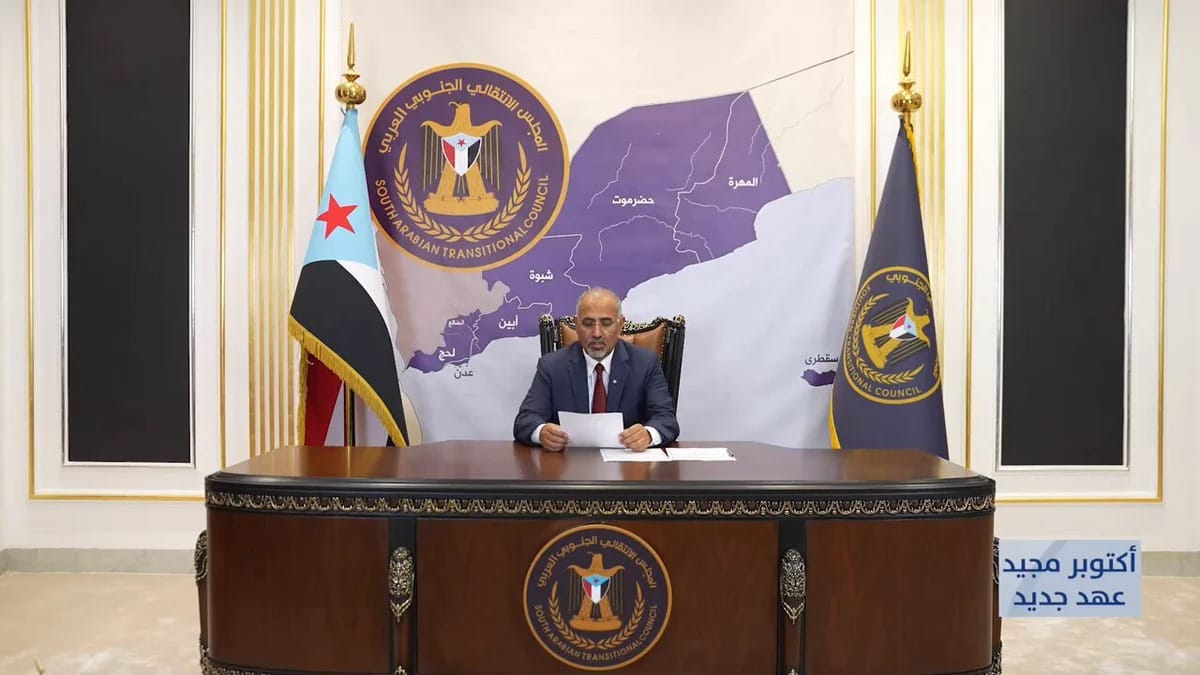
Months after fleeing following the events in Hadramout and Mahra, the leader of the dissolved Southern Transitional Council, Aidarous al-Zubaidi, appeared in a televised speech for the first time. In it, he demanded that Saudi Arabia recognize the separatist steps he announced in January 2026, affirming the continuation of what he described as the "regional and international struggle to seize our people's right to self-determination and restore their independent, fully sovereign state."
Al-Zubaidi reiterated his commitment to the constitutional declaration he announced last January, calling for general mobilization against the Houthis according to measures he said he had mandated. He also condemned the Houthi attacks on Saudi Arabia.
His appearance, amidst the confrontation with the Houthis and the escalation shifting from Yemen to Saudi Arabia, has sparked varied interpretations among Yemeni and Saudi writers and activists regarding its timing and implications. Some see it as an attempt to regain political presence and bolster the separatist project, while others view his speech as signaling a rapprochement with Riyadh and alignment with the fight against the Houthis.
Questions Regarding Riyadh's Stance
Journalist Marib Al-Ward, in a commentary titled "How Does Saudi Arabia View Al-Zubaidi's First Appearance?", questioned Riyadh's position on his audio-visual appearance, noting it was the first since early last January, following the events that led to the rift between Saudi Arabia and the UAE and the revocation of his membership in the Presidential Leadership Council.
Al-Ward pointed out that the official Saudi news channel Al Ekhbariya had affirmed that the Kingdom would treat any statement from Al-Zubaidi as originating from Abu Dhabi. He noted that Saudi journalist Mazen Al-Rouqi described his appearance as representing a "red line" for Riyadh.
Al-Ward said that Al-Zubaidi's speech did not include any attack or criticism of Saudi Arabia, unlike some of his previous statements which contained indirect attacks. Instead, it included a clear condemnation of Houthi attacks on its territory. However, he believed the appearance, its timing, and the context in which Saudi Arabia faces unprecedented challenges since the war began, raise questions about its significance, intended messages, and the UAE's connection to it. He considered that the coming days will reveal the answers to these questions.
Differing Interpretations of the Speech's Goals
For his part, writer and political activist Amer Al-Dumaini said the speech reflects the continuation of the separatist trend and Al-Zubaidi's adherence to the secession project. This is shown by his return to the constitutional declaration he announced last January, which he said was the reason for his dismissal and accusation of high treason.
Al-Dumaini added that Al-Zubaidi is exploiting the confrontation with the Houthis to return to the forefront and to create confusion for the Presidential Leadership Council and the Yemeni government. He considered that his speech re-entrenches the division within the pro-government and pro-Saudi camp at a time when the stage requires uniting ranks and overcoming differences.
He opined that Al-Zubaidi's appearance from the UAE, the country where he recently settled, means that Abu Dhabi is bringing him back to the forefront, whether to pressure Saudi Arabia or as part of an understanding with it, a possibility he considered less likely. He also said the speech serves the Houthis, deepens societal division, and reopens the door for debate and conflict within Yemen.
Al-Dumaini noted that Al-Zubaidi, in his speech, repeated talk of secession, monopolizing the representation of the South, and breaking with other components of society, which, in his opinion, are among the main criticisms previously leveled against him and the Southern Transitional Council.
In contrast, journalist and writer Abdul-Raqib Al-Hadyani offered a different reading of the speech, considering Al-Zubaidi's appearance at this stage as further proof, in his view, that the Houthis are facing a critical situation and that there is an international inclination to end their presence in Yemen.
Al-Hadyani said that Al-Zubaidi called for general mobilization against the Houthis and the protection of international waterways, in line with the battle being fought by Yemen and Saudi Arabia against the group.
He considered his condemnation of the Houthi attacks on the Kingdom an attempt to get closer to Riyadh, and saw it as a belated admission that the solution passes through it, alongside what he described as an implicit retreat from the December and January rebellion in Hadramout.
He added that Al-Zubaidi's affirmation of the constitutional declaration issued in January reflects, according to his reading, an attempt to address his base in parallel with the messages directed to the Kingdom.
Al-Hadyani pointed to the appearance of a map of the Republic of Yemen in the background of the speech, explaining that it showed the southern and eastern governorates, while keeping the structure of the northern governorates visible without names. He considered that this carries more than one interpretation and does not necessarily confirm a separatist orientation in the speech itself.
Al-Hadyani concluded that the speech, in his assessment, contained positive aspects, most notably its harmony with the battle against the Houthis and the attempt to get closer to Riyadh.
In turn, journalist Maan Dammaj raised questions about the significance of the appearance, saying that Al-Zubaidi's televised speech, his first since the events of January 2026, presents two possibilities: either exploiting the circumstances to return to the forefront, or an Emirati escalation to pressure Saudi Arabia in what he described as a moment of weakness.
Saudi Criticism of the Appearance's Timing
In Saudi reactions, Saudi activist Fayez Al-Malki said that Al-Zubaidi is deluded into thinking that his appearance, coinciding with the ongoing military operations of the Saudi-led Coalition to Support Legitimacy, will affect the course of "Fajr Al-Yaman" (Yemen's Dawn). He added that the liberation of Yemen, as he put it, is a matter of time, and that Yemenis will continue to confront the Iranian project and its tools.
For his part, Abdulrahman Al-Malki considered the timing of Al-Zubaidi's appearance a preemptive and deliberate step to impose his political presence and capitalize on any potential field gains as the military battle develops, in addition to keeping the southern scene in a state of constant tension.
He said the appearance could contribute to deepening internal division and diverting focus from confronting the Houthis, thereby opening the door for side conflicts that confuse the Yemeni scene.
In turn, the former Director-General of ISESCO, Abdulaziz bin Othman Altwaijri, said that bringing out Al-Zubaidi at this time comes, as he put it, to cause confusion and sabotage, coinciding with what he described as the collapse of the terrorist Houthi militias.
Source: Almahriah Net - Open sources