Displacement Grows in Taiz and Hodeidah.. Families Flee Homes in Search of Safety
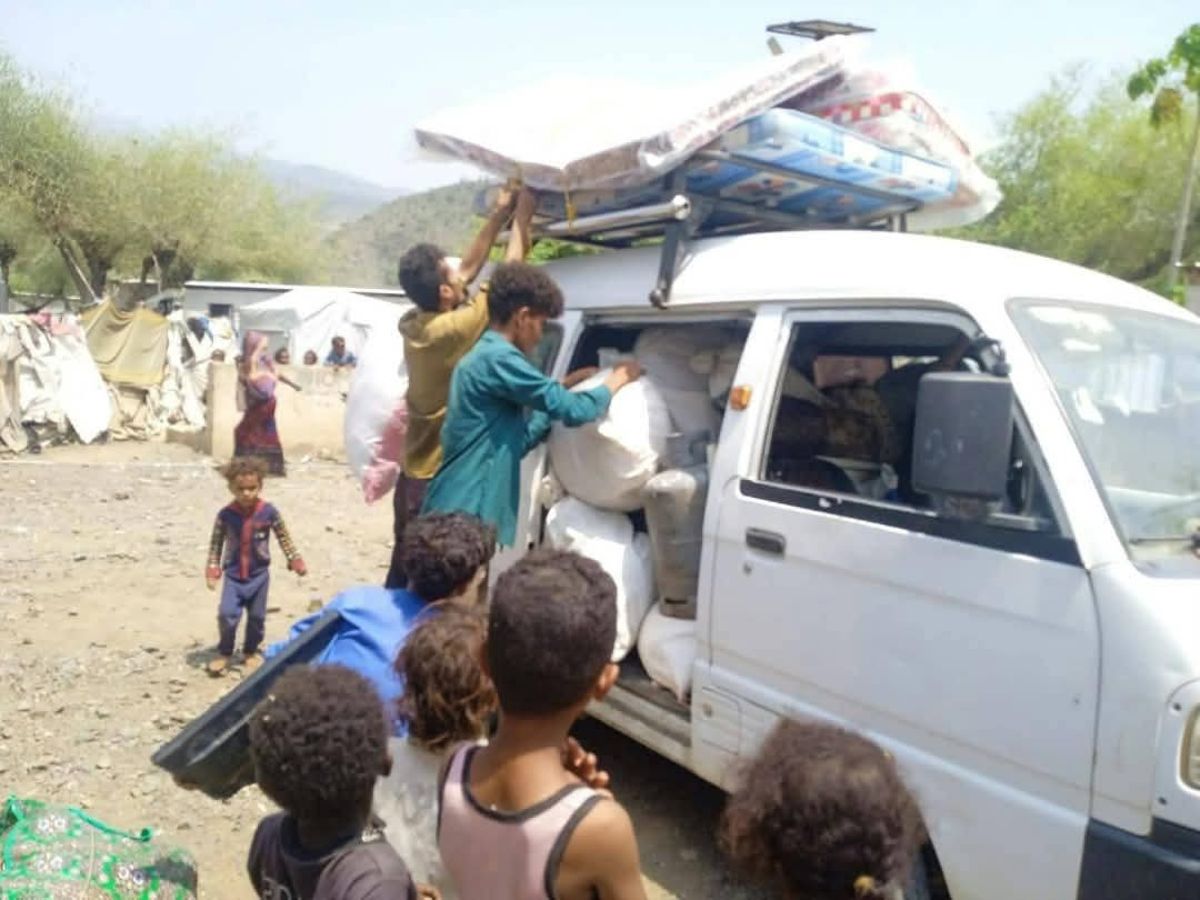
The repercussions of the military escalation in western Taiz governorate and the West Coast regions are widening, with escalating clashes and shelling in recent days forcing hundreds of families to leave their homes and displacement camps for fear of the conflict expanding.
The escalation has extended to areas in Taiz and Hodeidah governorates, including the districts of Maqbanah, Jabal Habashi, Hays, and Al-Khokha. Amid rapid military movements, residents and displaced persons have been forced to seek safer areas, while displacement camps suffer from a severe shortage of basic necessities.
In western Taiz, the escalation's impact has reached several villages and sub-districts, extending to the road connecting Taiz city and Mocha in the Al-Kadahah sub-district. Meanwhile, fears of widening clashes have prompted other families to leave their areas, afraid of direct confrontations reaching them.
According to the monitoring by the Executive Unit for IDP Camps Management, as of the evening of Friday, September 4, 1,395 families have been displaced in Taiz and Hodeidah governorates in a new wave of displacement. This adds pressure on host areas and camps, which are already facing limited resources and continuously rising needs.
The losses for displaced families are not limited to leaving their homes. Many are forced to abandon their property and sources of income, including money, livestock, and shelter materials, in an attempt to secure their family members' lives and move away from the escalation zones.
Displaced for the Second Time
Among these families is that of Mohammed Amin Al-Shamiri, a 35-year-old father of six, who found himself facing a new displacement experience after years spent away from his hometown.
Al-Shamiri says he was first forcibly displaced from "the Shamir Maqbanah district, his original home" to the Al-Ma'afir district, and was displaced a second time in 2023 to the Al-Shuraijah camp. He remained in the camp for years before the recent military escalation forced him to flee again towards the "Ibn Khawlan" valley in the Jabal Habashi district.
Al-Shamiri told "Almahriah Net": "We left under very harsh conditions and could only carry light luggage. Our only concern at that time was to survive and get the women and children away from the atmosphere of escalation and the unprecedented hours of terror they were experiencing."
He continued, "During the displacement, we received support from government forces, but the drones flying in the area's skies instilled indescribable terror in the women and children, destroying what little sense of security we had left, to the point where we thought for a moment that we would never survive."
Hardship in Displacement Sites
After arriving at the new displacement site, Al-Shamiri and his family found themselves facing difficult living conditions, with a lack of basic necessities and shelter materials.
He says the camp they recently arrived at "lacks many basic necessities." He noted that a number of displaced people are still trying to transport materials from their tents at the previous displacement sites.
Al-Shamiri appealed to humanitarian and relief organizations, calling for an urgent response for the displaced and the provision of their basic needs amid the ongoing wave of displacement.
Escalation Exacerbates Displacement
In this context, Najib Al-Saadi, director of the Executive Unit for IDP Camps Management in Taiz governorate, says that "on Thursday, September 3, 2026, the Maqbanah district witnessed a military escalation by the Houthi group, targeting sub-districts, villages, camps, and gatherings of displaced people in the Maqbanah and Jabal Habashi districts, resulting in the displacement and forced eviction of a number of families."
Al-Saadi added, in a statement to "Almahriah Net," that: "The waves of displacement have worsened in a number of villages, sub-districts, and camps in western Taiz, as a result of continuous shelling that targeted residential neighborhoods and shelters for the displaced."
He explained that the escalation has caused fear and panic among residents and the displaced, prompting an increasing number of families to leave their homes and displacement sites in search of safer areas.
According to data from the Executive Unit, as of September 3rd, the Maqbanah district recorded the displacement of 327 families from the "Al-Yaman" sub-district, 150 families from the "Al-Quhaifah" sub-district, 135 families from the "Al-Ashmilah" sub-district, in addition to 95 families from the "Al-Abdalah" sub-district.
In the Jabal Habashi district, the number of displaced families reached 165, most of whom reside in displacement camps, bringing the total number of displaced families in the two districts to 872. He confirmed that "this figure does not include the number of recently displaced families."
Al-Saadi pointed out that the Executive Unit, with continuous follow-up from the Prime Minister, is working to receive the displaced, arrange their situations, find them shelter, and communicate with international and local organizations to provide humanitarian needs.
He noted the presence of community cooperation in receiving and accommodating the displaced in homes in the districts of Jabal Habashi, Al-Shamayatayn, Al-Khokha, and Mocha.
He warned of a potential increase in the number of displaced people in the coming days if the escalation, tensions, and security incidents continue.
Displacement Extends to Hodeidah
In Hodeidah governorate, Jamal Al-Mashra'i, director of the Executive Unit for IDP Camps Management, confirms that: "The new wave of displacement from areas adjacent to the West Coast is a result of military escalation and shelling that targeted citizens' homes." He noted that "the number of displaced people is increasing as clashes continue."
Al-Mashra'i added, in a statement to "Almahriah Net," that "the Executive Unit is monitoring the displacement movement in coordination with local authorities in the governorates and districts, through operations rooms in the main office and the unit's branches, in addition to submitting daily reports and monitoring the conditions of the displaced."
He explained that the number of displaced families that arrived in Hodeidah governorate reached, as of Friday, 222 families in the Hays district and 39 families in the Al-Khokha district, noting that these figures do not include all the families that arrived later, as the influx of displaced people continues.
He pointed out that the current wave of displacement began in July, following an escalation of shelling by the Houthi group using mortar shells and drones, which prompted citizens to leave their homes and property for fear of their lives.
Al-Mashra'i indicated that the areas with the highest recorded cases of displacement are in the rural areas of Al-Jarahi, Jabal Ras, and the areas adjacent to the Hays district, while the majority of displaced families are heading to the city of Hays, followed by the Al-Khokha district.
He stated that the flow of displaced people has been significant in recent days, and the displacement movement is still ongoing. New numbers have arrived in the Hays district that were not included in the Executive Unit's latest report as of Friday.
He explained that shelling and escalation are the main reasons for families leaving their areas, noting that some displacements came from areas that did not witness direct confrontations, including the city of Hays, due to fears of the conflict expanding.
Increasing Needs
According to Al-Mashra'i, displaced families face multiple needs, most notably shelter, cash and food assistance, clothing, identification documents, and psychosocial support. He called on humanitarian organizations to respond quickly to these needs.
With the continued displacement, Al-Mashra'i called for a cessation of clashes and a return to the dialogue table, stressing the importance of reaching a political solution that achieves peace and stability.
He also called on international organizations and donors to act quickly to protect the displaced and provide their basic needs amid the ongoing escalation and the increasing number of affected families.
Source: Almahriah Net