Leadership Council Head Announces Amnesty for Houthi Defectors, Calls for General Mobilization
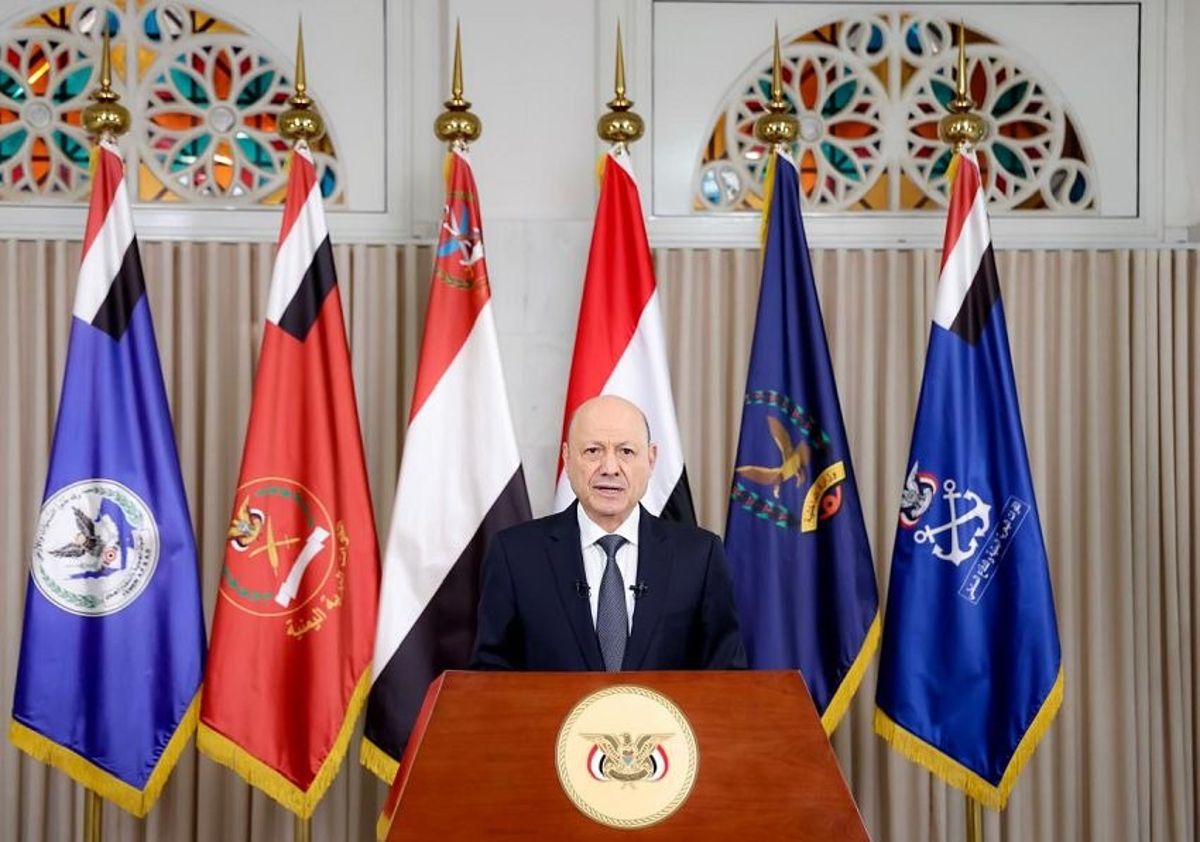
The Chairman of the Presidential Leadership Council, Rashad Mohammed Al-Alimi, called on Yemeni citizens for a general mobilization and to join the armed and security forces through official channels, announcing a safe return to the republic and constitutional legitimacy for anyone who leaves the Houthi group and stops fighting or working for it.
In a speech to the nation on the 64th anniversary of the September 26 Revolution, Al-Alimi said that the state would open the door for return, stemming from its responsibility to spare Yemeni blood, end the war, and prevent acts of revenge and retaliation.
He confirmed that anyone who, starting from the eve of September 26, leaves the Houthi militia and ceases to fight in its ranks or work for it, will be covered by a comprehensive amnesty to be issued later in accordance with constitutional and legal procedures. This includes a commitment to regularize the status of army and security personnel in a way that preserves their legally acquired job rights.
The Chairman of the Leadership Council called on the people for a national mobilization, to rally around the armed and security forces, join their ranks through official channels, and contribute in any way they can to defend the republic and state institutions.
He said the current stage represents a "historic moment" for Yemenis to rise up, return the country to its path, and honor the sacrifices of the early fighters, human dignity, and the right of Yemenis to security, education, work, and a future free from violence and what he described as cross-border racist and sectarian militia projects.
Al-Alimi called on brotherly and friendly nations wishing to achieve security and stability in Yemen and the Red Sea to stand with the people, the government, and the armed forces, and to support the coalition led by the Kingdom of Saudi Arabia to rid the country of the Houthis, considering the restoration of state institutions to be in the interest of Yemen, the region, and the world.
He stressed that Yemen deserves a future worthy of its history, location, and the potential of its people, and to be part of the region's renaissance and prosperity, not an arena for chaos, a platform for pre-state projects and "myths of divine right," or a source of threat to the security of neighboring countries and regional and international peace.
He said that the attacks and violations carried out by the Houthi militia represent a dangerous escalation, placing the state leadership before its constitutional and moral responsibility to deter the threat and protect civilians, after the group, according to him, chose the logic of force and arms over dialogue and peace.
He pointed out that the events in areas of Taiz, Ma'rib, Al-Jawf, Al-Hudaydah, Lahij, Hadramaut, Al-Bayda, Shabwa, and Al-Dhale represent an extension of the path of sabotage and an attempt to impose a new reality by force at the expense of Yemeni blood, security, and the country's future.
He warned that the danger goes beyond that, saying, "The Houthi project aims to turn our land and coasts into a continuous threat to the security of Yemen and the entire region."
Al-Alimi said that experience has proven that making concessions to the Houthis does not lead to peace, but rather gives them an opportunity to reorganize their ranks and prepare for a new round of escalation, returning the country to a spiral of war and conflict.
He stressed that the Houthi militia initiated the escalation within Yemen and across its borders and, according to him, caused the killing of civilians and the terrorizing and starving of the Yemeni people, emphasizing that the state will take the necessary measures to protect civilians, civil peace, and the country's supreme interests.
He said that "major national battles are not measured by an advance here or a retreat there, nor by a position that changes from one day to the next, but by the clarity of the goal, the strength of will, and the ability to turn crises into opportunities and challenges into additional reasons for strength and cohesion."
He added that the goal is to restore state institutions and extend their sovereignty over all national territory, all the way to Sana'a.
Al-Alimi addressed citizens in the governorates under Houthi control, saying that they were and still are at the heart of the state's responsibility, as they bear the greatest burden of the war's suffering, stressing that this suffering "should not become a permanent fate" for them.
He said the state does not view the residents of these areas as a party to the conflict, but as "its people, its partners, and those with the primary right to peace and stability," adding that what was imposed on them by force of arms does not detract from their status or their right to a homeland that embraces all its citizens.
He called on the people of these areas to preserve the lives and future of their children and not to throw them as fuel for the Houthis' wars and adventures, saying that every young person saved from the group's project "is a building block in the new Yemen, reconciled with itself, its neighbors, and the international community."
The Chairman of the Leadership Council praised the stances of the Yemeni tribesmen alongside the state, its institutions, and the armed and security forces, stressing the state's reliance on continuing this role in solidarity, unity, and preventing vendettas and revenge.
Al-Alimi, on behalf of himself, the members of the Presidential Leadership Council, and the government, renewed the commitment to the outcome of the Southern-Southern dialogue sponsored by the Kingdom of Saudi Arabia, ensuring a just and comprehensive solution to the Southern issue.
The Chairman of the Leadership Council congratulated the Yemeni people, the heroes of the armed forces, security, and military formations stationed on the various fronts of honor, and the families of the martyrs and the wounded, on the 64th anniversary of the September 26 Revolution.
He said that the best way to celebrate September is to honor the sacrifices of the Yemenis who created their republican glory, and for this glory to remain present in the state institutions and in the hearts and consciences of Yemenis, and for the people's interest to remain above all considerations and the law above all.
Source: Saba Net